Cardiovascular Workforce Development

You can't hire your way out of the cath lab shortage.
You can train your way out.

CardioPathway is the core educational infrastructure a cardiovascular service line needs — structured, RCIS/RCES-aligned programs that turn the clinical staff you already have (telemetry techs, EMTs, rad techs) into cath-lab-ready technologists.

◆ Workforce infrastructure for the cardiovascular service line — not just a course.
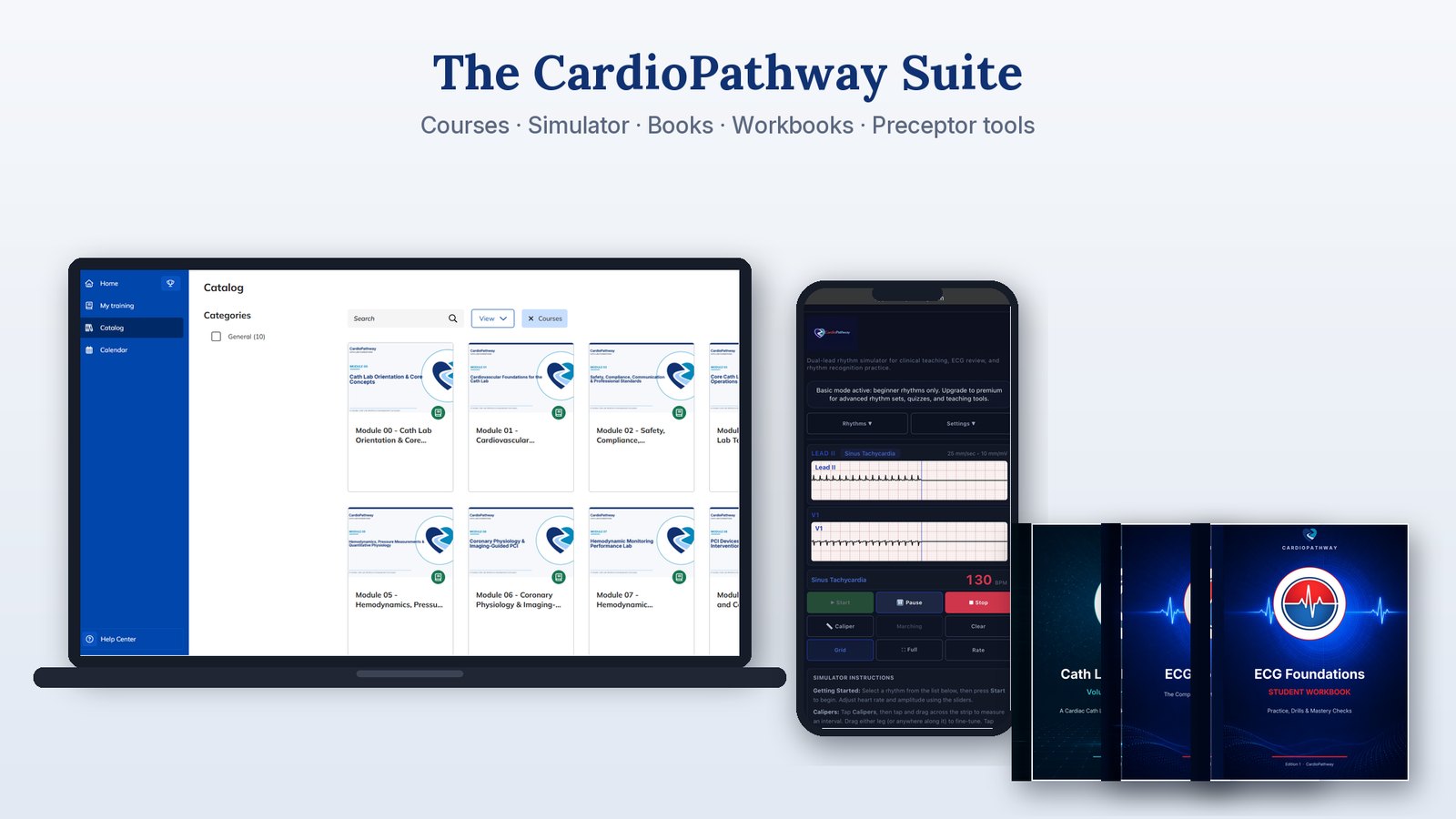
The CardioPathway Suite — courses, simulator, books, workbooks, preceptor tools
~900K
Cath procedures performed in the U.S. every year
+11%
Projected growth in the CV tech field, 2023–2033 (BLS)
Low 100s
Invasive-track graduates produced nationally each year
The solution, in one line

Stop improvising onboarding. Build your own pipeline.

One connected curriculum across the cardiovascular service line — so readiness stops depending on who was free to teach that day.

📚

A real curriculum

RCIS/RCES-aligned programs across ECG, the cath lab, and EP — built for the person who'll actually stand in the room.

🧭

A structured path

Sequenced modules, a dual-lead rhythm simulator, workbooks, and mastery assessments, so onboarding is the same every time.

🩺

Tools for your team

Preceptor guides and competency tracking that turn one great preceptor's knowledge into a repeatable standard.

Free Interactive Tools

Two free simulators. Try them in your browser.

The rhythm strips and the pressure waveforms every cardiovascular tech has to read on sight — live, measurable, and free to start.

The rhythm simulator — dual-lead, real time, 40+ rhythms with calipers, marching and rate tools

Free to try — no signup.

Try the ECG simulator
The hemodynamics simulator — every cath lab waveform, time-locked to the ECG, with a/v waves, x and y descents, and right-heart and LV-to-aorta pullbacks

Free: the normal waveforms and pullbacks · pathology (pulmonary hypertension, shunts) is premium.

Try the hemo simulator
In development

The EP Simulator — coming soon

Intracardiac signals, activation mapping, and stimulation maneuvers — in the same live, measurable format. Building now.

The Problem

This isn't a hiring problem.
It's a supply problem.

Cardiovascular procedure volume keeps rising. The trained workforce to support it doesn't exist in the numbers hospitals need — and no amount of recruiting creates people who were never trained.

Demand ↑ Training supply the widening gap TODAY 2033 +

Procedure volume and the 65+ population keep climbing while the training pipeline stays flat. Every year the gap widens — and it can't be recruited shut.

Demand is climbing

  • ~900,000 PCIs a year in the U.S.
  • +11% field growth 2023–2033 — much faster than average
  • ~9,400 annual openings across the CV-tech group
  • Cath lab market growing ~5.8%/yr to 2035

Supply is stuck

  • Low hundreds of invasive-track grads a year
  • 41 accredited CVT programs nationally*
  • Only 2 with any EP track — often requiring relocation
  • Small cohorts, geographically uneven

Why you can't recruit your way out

Travel and agency staffing became the default stopgap — but the agencies draw from the same shallow pool. Even they can't recruit enough, because the trained people simply aren't out there. Distribution isn't the problem. Supply is.

Traveler premiums

Travel cath lab techs average ~$74/hr and run as high as $112/hr, against a staff average near $29/hr — roughly a 130% premium for a body that never builds your permanent team.

A staffing crisis, not a blip

96% of programs report trouble staffing their cath labs, 85% say it's harder than before the pandemic, and some report 30% vacancy.

Preceptor burnout

~33% burnout prevalence among cath-lab RNs and RCIS staff — and call burden is the single largest driver of interventional staffing strain. "Nine straight days of call" is a real headline.

Improvised onboarding & slow ramp

No standard plan, learn-by-doing, different every time — and 6–12 months to full independence, every month carrying a cost.

One poorly prepared hire — or one quarter of traveler coverage — costs more than a CardioPathway license. The status quo isn't free; it's just an invisible bill. The way out isn't more recruiting. It's building your own pipeline.

See how we fix it →

*Program counts confirmed against the CAAHEP accredited-program directory (caahep.org, accessed August 2026): 41 accredited Cardiovascular Technology programs nationwide, of which only two (Loma Linda University, CA and Sentara College of Health Sciences, VA) offer a Cardiac Electrophysiology track. Sources: BLS Occupational Outlook Handbook (Cardiovascular Technologists & Diagnostic Sonographers); NCDR CathPCI Registry; CAAHEP program directory; Vivian Health / industry travel-pay data; MedAxiom & Cardiac Interventions Today staffing surveys; Cardiology Research burnout study; HMP Cath Lab Digest. CardioPathway executive briefing (v6) consolidates the workforce figures.

How It Works

Convert the staff you already have.

Your telemetry techs, EMTs, and rad techs already have a clinical foundation. What they lack is a structured path into the cath lab. CardioPathway is that path — delivered through a hosted LMS, so it runs remotely and scales past any one location.

Book a call to see it
The staff you already have telemetry techs · EMTs · rad techs The CardioPathway pathway Assess → Fundamentals → Practice → Precept same sequence, every hire — on a hosted LMS A cath-lab-ready technologist one you trained — and one who stays Your own pipeline, not a rented one.

Assess & place

Start each person at the right program for their background — no one-size onboarding.

Learn the fundamentals

ECG, hemodynamics, anatomy, safety — the same content every time, never dependent on who was free.

Practice

A dual-lead rhythm simulator, workbooks, and mastery checks turn reading into recognition.

Precept to a standard

Competency checklists and preceptor guides make readiness something you sign off — not guess at.

Programs

A complete pathway — from the first ECG to the EP lab.

Not a course. A connected curriculum across the cardiovascular service line, each program print-ready and LMS-ready, with workbooks, assessments, and instructor tools.

Cath Lab Foundations
Cath Lab

Cath Lab Foundations

The scrub-tech pathway into the cath lab — hemodynamics, coronary anatomy, PCI, safety.

12 modules · two volumes · RCIS-aligned
See the program →
ECG Foundations
Rhythm

ECG Foundations

A ground-up rhythm interpretation course with real strips and a built-in simulator.

28 modules · rhythm simulator
See the program →
12-Lead ECG & Stress Testing
Diagnostics

12-Lead & Stress Testing

Axis, STEMI localization, and a full stress-testing course for the diagnostic side.

EP Foundations
Electrophysiology

EP Foundations

The electrophysiology pathway — signals, mapping, ablation, devices — where training is scarcest.

19 modules · two volumes · RCES-aligned
See the program →
Cath Lab Process and Procedure Manual
Reference

Process & Procedure Manual

The technologist's procedural reference for the cath lab — the standards and steps behind every case.

Cath lab P&P · print + digital
See pricing →
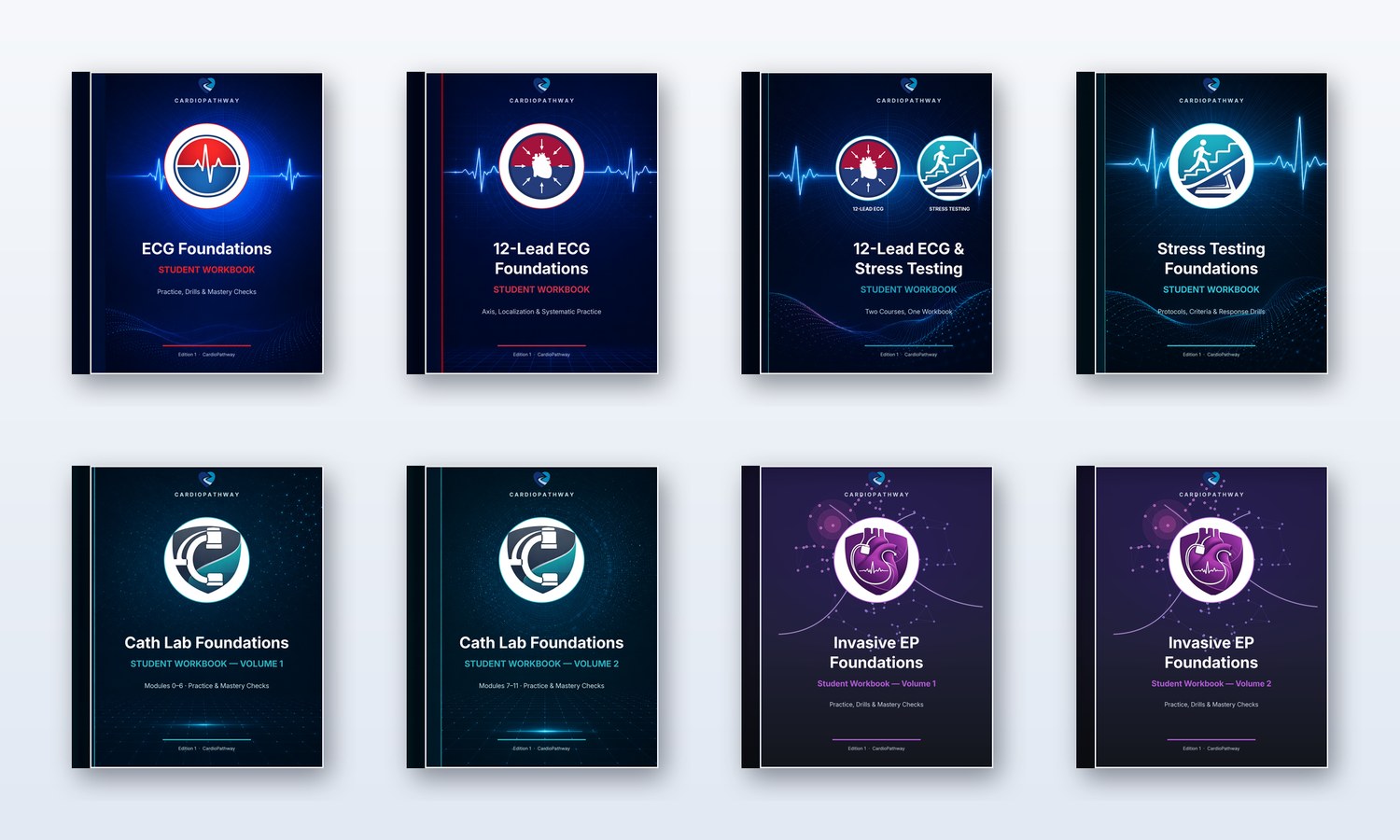
CardioPathway student workbooks — one for every course
Practice

Student Workbooks

A companion workbook for every course — drills, practice, and mastery checks, built to be worked in.

One per course
See pricing →
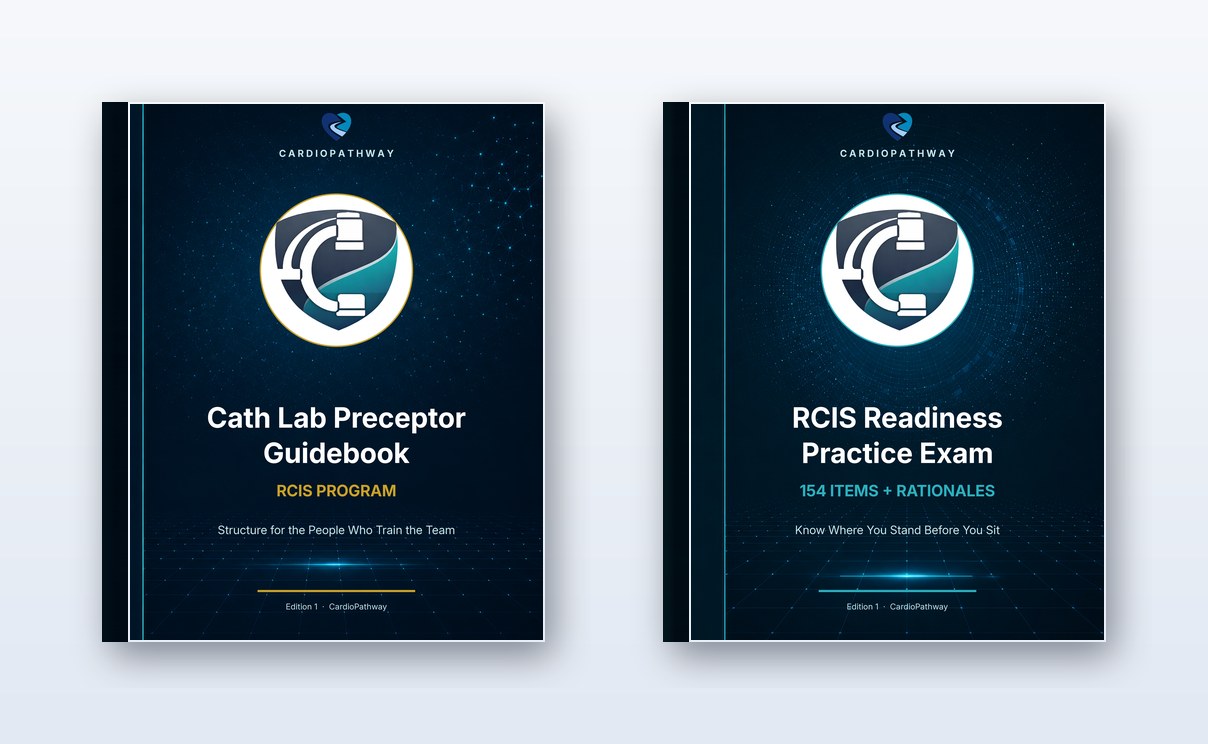
CardioPathway preceptor guidebook and RCIS readiness practice exam
For preceptors

Preceptor Tools

A preceptor guidebook plus a 154-item RCIS readiness practice exam — structure for the people who train the team.

Guidebook + practice exam
See pricing →
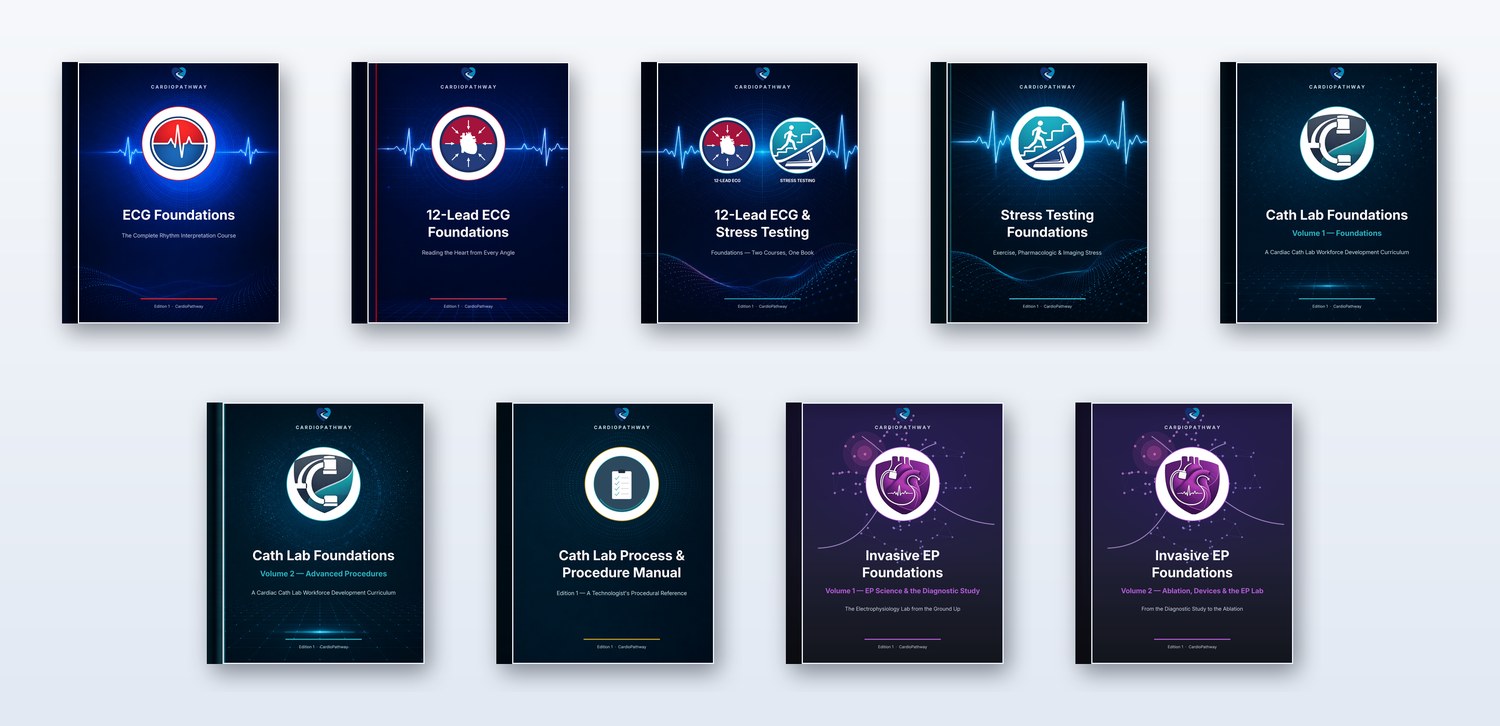
The complete CardioPathway library — all nine volumes including the EP set
The full suite

The complete library

Eight volumes, the workbooks, the manual, and preceptor tools — one connected pathway across the service line.

Every course ships with a student workbook · mastery exams · a preceptor guidebook · a readiness practice exam — print-ready and on a hosted LMS.
For Cath Labs

Give your lab a training program it doesn't have to build.

You don't have time to write a curriculum, and your preceptors don't have time to be instructors. CardioPathway is the structured onboarding your lab has been improvising — ready to run.

A complete RCIS-aligned curriculum

On a hosted LMS, with the rhythm simulator, workbooks, and mastery assessments included.

Preceptor guides & competency tracking

A defined, sign-off-able path from new hire to independent tech — the standard your lab has been missing.

The 90-Day Launch Guarantee

Set up and running in 90 days.

We'll have your curriculum live on your LMS, your preceptor tools in place, and your first cohort onboarding within 90 days of signing — guaranteed. We map it to your lab on a call.

Book a call

Every lab is different — size, case mix, where your new hires come from. A 15-minute call lets us fit the program to your lab and give you real numbers, not a generic quote.

For Techs & Students

Trying to get into the cath lab? Start here.

Whether you're a telemetry tech eyeing the cath lab, a student studying for the RCIS, or a new hire trying to stop feeling lost in the room — this is built for you.

Free

The free simulators

Practice rhythms and cath lab hemodynamics free, in your browser — dual-lead strips and live pressure waveforms, with calipers.

Free

The field guides

The numbers, waveforms, and language of the lab — on pages you'll keep.

The full programs

When you're ready to go deep — the same curriculum labs run, module by module.

Free Resources

Free references, no catch.

Real tools you'll actually use — we just ask for an email so we can send them (and the occasional useful reference). No spam.

The Cardiovascular Workforce Briefing
For hospital & service-line leadership

The Cardiovascular Workforce Briefing

A 12-page briefing on the invasive cardiology & EP staffing gap — the national data, what it costs, and how to build the pipeline you can no longer recruit. Free.

Get the free briefing →
PDF · Free

The Cath Lab Field Guide

Normal pressures, the six waveforms, coronary territories, and safety — the essentials on a few pages.

PDF · Free

The Rhythm Reference Pack

Read any rhythm in five steps, plus the can't-miss rhythms every new tech should know cold.

2 min · Anonymous

The State of Cath Lab Onboarding

Our survey. Take it and get the results — every response makes the case that new techs deserve real onboarding.

The Founder

I built the pathway I couldn't find.

I'm Steven Chambers, founder of CardioPathway — and getting into the cath lab took me six years.

Not for lack of trying, and not for lack of clinical work. I spent those years as an ECG tech, a telemetry tech, a stress-testing tech, an EMT, and an educator — building the foundation the whole time. What I couldn't find was the path: a structured way to turn all of that experience into a cath-lab-ready technologist. No one could point me to it, because it didn't exist.

That's when it clicked. The cath lab shortage isn't really a hiring problem — it's a pathway problem. There are capable, motivated people one clear route away from filling these roles, and that route was never built.

So I built it. CardioPathway is the structured path I spent six years looking for: a real curriculum that takes the clinical staff a hospital already has — the ECG techs, the tele techs, the EMTs — and gives them a defined way into the cath lab and the EP suite. It's the training I wish someone had handed me, and the standard I want every tech who comes after me to start with.

That struggle is exactly why the motivation behind this runs so deep. I'm not building it from the outside looking in — I'm building the thing I needed.

— Steven Chambers, Founder
Book a Call

Let's see if CardioPathway fits your lab.

A 15-minute call — no pitch deck, no pressure. Tell us about your lab and where your new hires come from, and we'll tell you honestly whether we're a fit.

Prefer email? steven@cardiopathway.com · 970-396-1438

FAQ

Questions, answered.

Is this accredited / does it grant CE?
CardioPathway is RCIS/RCES (CCI)-aligned educational content. It supports — and does not replace — your facility's training and protocols, and it is not a CE provider.
Who is it for?
Labs onboarding new techs, and the clinical staff moving into them — telemetry techs, EMTs, rad techs, and RNs building cath-lab and EP readiness.
Do we need to build anything?
No. It runs on a hosted LMS, so there's nothing to stand up on your side — it works remotely and scales past any one location.
What does it cost?
It depends on your lab's size and scope. Book a call and we'll give you real numbers tailored to your program — not a generic quote.
Can individuals buy it?
The full programs are built for labs, but individuals can start free with the ECG and hemodynamics simulators and the field guides. Ask us on a call about individual access.
How fast can we start?
Fast — we scope it on a 15-minute call, and our 90-Day Launch Guarantee means your program is live and your first cohort is onboarding within 90 days of signing. No long implementation.